

Hold a meme coin. Get paid in USDT.
$14 taxes every trade 3% on the way in and 3% on the way out and pays it straight to holders on-chain. Not points. Not emissions. Real money, split pro rata, every cycle.
The plan was to pay you in McDonald's stock. It is not a plan we dropped — it is a switch we have not been able to flip yet, for reasons we measured and publish below, with a live meter for when it changes. 🍟
Contracts are written, tested and unaudited. Not deployed — there is no token to buy yet, and anything claiming otherwise is not us.
$14
Order #0001 · dine in
Thank you · come again
🍟
Next: the stock
live
The switch happens when a tokenized McDonald's share can actually be bought here.
Read off BNB Chain, not typed by us. When this bar fills, the reward stops being a stablecoin.
MCD share price
$247.92
+0.18% vs 24h
MCDon on BNB Chain
951
What we intend to pay in
Of it, tradeable
404.31
Tradeable there. Not much.
USDT distributed
—
Opens at launch
Lore
The $14 meal deal
Fourteen dollars is roughly what a combo meal costs now. That is the whole joke — and it is also the whole thesis. The price of the meal went up. It went up for somebody, and that somebody owns shares.
You cannot do much about the price of lunch. You can end up on the other side of the counter, a fraction of a share at a time, paid for out of other people's trading. It is a stupid idea executed carefully, which is the only kind worth shipping.
One MCDon share is worth about
18
combo meals
At $247.92 a share and $14 a combo. Moves with the live price.
And the other fourteen
Changpeng Zhao's first job was behind a McDonald's counter in Vancouver, at $4.50 an hour. Asked how old he was, he says “fourteen or fifteen.” He went on to build Binance.
This token runs on his chain, and it is built to buy the stock of the company he started at. Fourteen dollars, roughly fourteen years old, BNB Chain, McDonald's. We did not plan that — we just noticed it, and then we could not un-notice it.
And then we could not buy it here. A tokenized McDonald's share exists on this chain and cannot be had at a price worth paying: no venue delivers one, no bridge carries one, and the only three pools charge 31.5%, 80% and 88% in fees. We spent four days establishing that rather than shipping a claim we could not keep.
So it pays USDT, until it does not have to. That is not a retreat and it is not a maybe. The distributor already accounts in a way that serves a rebasing tokenized share, the migration path is written and tested, and the test that watches for the day it becomes possible is already in the suite. When there is a real McDonald's market on his chain, this becomes what it was always supposed to be — on the chain he built, buying the stock of the company he started at, fourteen dollars at a time.
How far off is the switch
951
MCDon exist on this chain
404.31
of those are tradeable
16
is what we would need
Read live from the chain every 60 seconds. When that bar fills, the test named testFork_McdonPoolIsStillTooThinToTradeThrough starts failing — and that failure is the signal to switch the reward, not a regression.
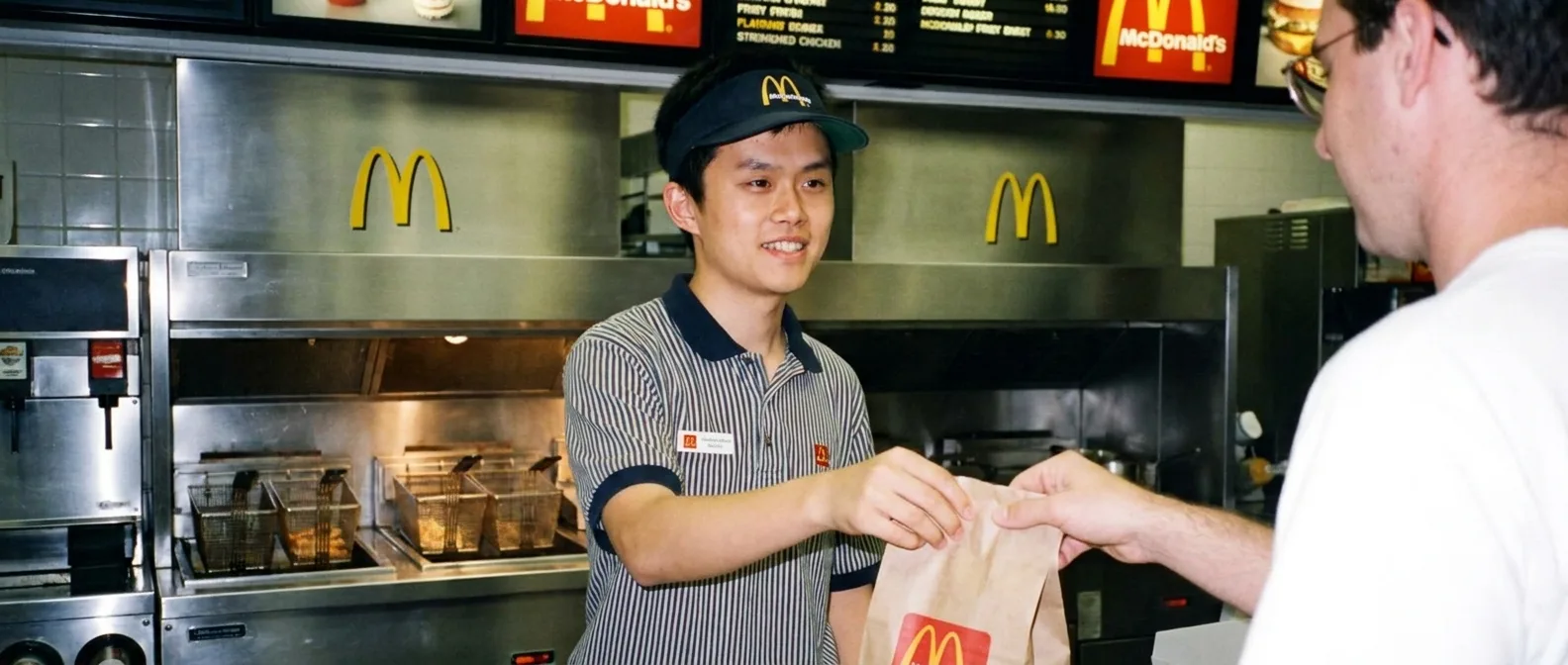
A generated clip of a first job — not footage of anything that happened, and not a likeness of anyone. Nobody in this story endorses this token.
Where this comes from
- The job, the age and the $4.50 are his own account on the All-In Podcast, where he also explains the wage sat below minimum under an exemption for chains employing teenagers.
- Emigrating to Canada in 1989 aged twelve, McGill, Bloomberg Tradebook, Fusion Systems, the 2013 poker game where Bobby Lee told him to put 10% into bitcoin, and Binance in July 2017: Wikipedia and SCMP.
- Accounts of the 2014–15 apartment sale differ on the year and the price, so it is left out rather than picked to suit the story.
$14
Order #0001 · where it started
He started behind a counter.
One day his chain buys the stock.
🍟
The asset
What you are actually being paid in
MCDon tracks McDonald's Corporation. This is its live price — the same instrument the vault buys and the distributor hands out, not a proxy or an index.
- Price
- $247.95
- Change over 30D
- −2.13%
- 30D high
- $256.96
- 30D low
- $235.72
Issuer
Ondo
Claim per token
> 1 MCD, and rising
Underlying
MCD · US5801351017
Mechanics
Where the money actually goes
- 01
Every trade pays a 3% tax
Buys and sells each carry 3%. The rates are constants in the contract — there is no setter, so nobody can raise them later.
- 02
The tax becomes USDT
Flap's tax processor swaps collected tax into the quote token and sends it to our vault. The vault is the only piece of this we deploy, and the only one that can change what holders get paid.
- 03
The vault fills the distributor
USDT moves from the vault to the distributor and is booked against every eligible wallet. The route that swaps it into a tokenized share first is written, tested, and dormant — it switches on the day one is buyable here at a sane price.
- 04
Holders get paid on-chain
The distributor splits every delivery across wallets holding at least 100,000 $14. Claim whenever you like — what you have earned sits there until you do, and nothing expires.
The part most projects hide
Step 03 was going to be the weak one. The plan was an exchange account, an API key and a human who set it up — a trust assumption no contract can remove. It turned out not to be available at all: no venue delivers a tokenized McDonald's to this chain. So the buy leg is on-chain instead, atomic, and the rail holds nothing between cycles. What the contracts guarantee after delivery is unchanged: the split is fixed by code, and the distributor can never owe more than it holds.
Reward engine
One cycle, five states, resumable at every one
Three of these five now happen inside a single transaction, which is what killing the exchange leg bought us: there is no window where money is in flight and nobody is sure where. The keeper still persists every transition, because a crash between quoting and swapping should resume rather than guess.
- 01COLLECTEDThe vault recognises what arrived, measured as a balance delta, and bounded by a daily budget.
- 02QUOTEDIf the reward is a token that must be bought, the route is priced and a minimum output derived from a live reference. A fill more than 1% off aborts the cycle.
- 03DELIVEREDThe reward lands on the distributor. When a swap is involved that is one transaction — pull, swap, deliver — and a fill under the minimum reverts the whole thing.
- 04BOOKEDThe distributor measures what actually arrived and adds it to the accumulator.
- 05DISTRIBUTEDGas-bounded batches push it to holders. Anyone can claim instead.
Max per cycle
$1,000
A bug cannot move the whole vault
Abort threshold
1%
Fill vs reference price
Routes allowed
Allowlist only
And never a token contract
The keeper is built; scheduling and alerting are what remain. The contracts on this page do not depend on it: they accept the reward from any source and account for it the same way.
Rails
What you get paid, and what we are waiting to pay you instead
This is the part of the project that did not go to plan, kept on the page rather than quietly deleted. The reward is USDT because no tokenized McDonald's share can be bought on this chain at a price worth paying. Everything needed to change that is already built, so the switch is a configuration change and a meter, not a promise and a roadmap.
USDT, straight through
Tax is collected, swapped to USDT, and booked to the distributor. Nothing is bought, bridged or held in custody, so there is no step here that can fail quietly. It is the least interesting reward we could pay and the only one that works today.
- Acquisition risk
- None — it is already the asset
- Per cycle
- $1,000 ceiling
- Jurisdiction limits
- None. It is a stablecoin
- Trust assumption
- Tether, and nothing we added
A tokenized McDonald's share
There is now enough depth on this chain to buy one at a sane price. The rail can be pointed at it and the reward becomes the thing it was always meant to be.
- Candidate
- MCDon or MCDx
- Rebasing reward
- Already handled, already tested
- What the switch costs
- A script. Not a relaunch
- Accrued rewards
- Claimable forever, either way
The distributor accounts in reward shares rather than balances, which is why it can serve a stablecoin and a rebasing tokenized share through the same code. Switching means deploying a distributor for the new asset and pointing the token at it — and because syncHolder is permissionless, anyone can help teach it the holder set. Nobody has to move a token, and rewards already accrued stay claimable from the distributor that holds them.
Estimate
Run your own numbers
Rewards scale with trading volume and with your share of eligible supply. Change the assumptions and watch what actually moves the outcome.
- Your share of rewards
- 0.500%
- Your USDT per month
- 997.3125
- Worth per year
- $12.0K
Assumes 3% of daily volume is collected as tax, minus Flap’s 10% protocol cut, minus 1.5% for swap fees and slippage, split pro rata across eligible wallets — about $199,462.50 reaching the pool per month at this volume. Volume is the input nobody can predict, and a token that stops trading pays nothing. This is arithmetic on your assumptions, not a forecast or a promise.
Your position
Claim what you have earned
Rewards open at launch
The contracts are written and tested but not deployed. Once they are live this panel reads your position straight from the chain — your balance, whether you clear the 100,000 $14 threshold, and the USDT waiting for you.
Tokenomics
One billion, fixed, no levers
- Total supply
- 1B
- Buy tax
- 3%
- Sell tax
- 3%
- To qualify
- 100K
Fixed at deploy, no mint
Frozen at launch by Flap
Frozen at launch by Flap
$14 held, per wallet
The tax rates are compile-time constants. Not owner-adjustable, not behind a timelock, not “temporarily” anything — there is no function that changes them. Owner powers cover plumbing only: swap thresholds, router and vault addresses, the AMM pair registry, fee exemptions, and renouncing.
Ranks
Where you sit on the org chart
Rewards are strictly pro rata — there is no bonus tier, no multiplier, no lock. The titles are a joke. The thresholds under them are the actual arithmetic of your share.
- 01 Crew100,000 $140.01%The floor. Below this a wallet accrues nothing.
- 02 Shift manager1,000,000 $140.1%Ten times the floor.
- 03 Franchisee10,000,000 $141%One percent of every single delivery.
- 04 Regional50,000,000 $145%Now it is a position, not a bag.
- 05 Board100,000,000 $1410%A tenth of supply. Behave accordingly.
Roadmap
What is actually done
No quarters, no dates, no “Q3: partnerships”. Four items, with the status written honestly, including the one that is a bit.
- 01Shipped
The contracts
Token, distributor and the acquisition rail, written and tested — 278 passing tests, 24 of them against live BNB Chain, including a stateful invariant suite that throws half a million random call sequences at the reward accounting looking for a state where a holder cannot be paid what they are owed. Three adversarial reviews have been run against it, plus one bug found by deploying the thing and using it like a buyer would. Everything found is fixed, and every attack is kept as a test. The full path from trading tax to a holder's wallet has been run against the real chain with a real aggregator route, not a mock. Unaudited.
- 02Next up
The keeper
Built, and far smaller than planned. Paying a stablecoin means no exchange client, no API key and no custody to reconcile. It rebuilds the holder set from Transfer logs, then syncs and books in one transaction — never one without the other. It signs through an encrypted keystore and never holds a key. What is left is scheduling and alerting.
- 03Waiting on 02
Launch
Audit, liquidity, AMM pair registered. No date, because a date would be made up. Ownership stays with a multisig while the reward asset still has to be able to change — renouncing would mean never being able to pay the stock.
- 04Obviously a joke
Buy an actual franchise
A real franchise runs to seven figures. At the current share price that is a lot of MCD. We are not saying it is the plan. We are saying nobody has said it is not.
Trust
What the owner key can and cannot do
Most rug vectors live in owner powers, so here is the full list on both sides. The right column is enforced by the absence of code, not by a promise.
The owner can
- Change the reward asset — which token the vault buys next, and the payout contract that hands it out. This is the point of the vault and the largest power there is, which is why ownership belongs on a multisig
- Set the daily budget the vault may convert, and allowlist which swap routers it may route through
- Recover tokens or BNB stuck in the vault — and so can Flap's Guardian, permanently, as a backup nobody can revoke
- Exclude an address from rewards, for pools and contracts that must never accrue
- Sweep reward from the distributor that nobody is owed
The owner cannot
- Change the 3% buy or 3% sell tax — Flap freezes both at launch and its token has no setter for either
- Change anything else about the token: not the supply, not the quote asset, not the tax split. It is immutable by construction, and not ours
- Mint, burn or blacklist a single token
- Pause transfers or freeze a wallet
- Touch rewards already accrued to a holder — sweeping recovers only the surplus above what holders are owed
- Take rewards out of an old distributor — those stay claimable forever
- Stop you claiming — not by retiring a distributor, not by excluding you, not by raising the payout minimum
- Move more than one day's budget out of the vault, however many transactions it takes
Audit status
Unaudited. The test suite covers tax maths, tracker invariants, gas-bounded batching and fuzzed solvency, and it runs against forks of live chain state — a real swap, a forced rebase, and payouts of the actual MCDon contract. The acquisition leg has been executed with real aggregator calldata: 100 USDT in, 0.13701 MCDon delivered to the distributor against a 0.13709 quote, then claimed by a holder. That is evidence, not an audit, and it is not a substitute for one.
Contracts
Read it yourself
$14 launches through Flap, whose tax token is immutable by construction — no setters, no way for anyone to change its rates or its dividend asset after the fact. That immutability is the point, and it is also why the vault exists: the asset holders are paid in has to be able to change, so it lives in a contract we deploy rather than in one nobody can touch. The factory above is what Flap calls to create that vault, and it is already on-chain, so you can read it before the token exists.
USDT is not our contract, and neither is the share we intend to replace it with. Both are issued by somebody else who keeps powers we cannot remove — pausing transfers, screening an address, changing a multiplier that governs every balance. The distributor is written to survive all three, and to account correctly whether the reward rebases or does not. We built around those facts rather than assuming they will not happen.
Questions
The obvious ones
- So what do I actually get paid in?
- USDT, on BNB Chain, pro rata to every wallet holding at least 100,000 $14. That is what the contracts pay today and what the site will keep saying until it changes. The intended reward is a tokenized McDonald's share, and the section above shows exactly how far off that is, measured live rather than asserted.
- Why not just pay the stock now?
- Because it cannot be bought here at a price worth paying. Backed's MCDx cannot reach this chain at all — no venue withdraws it here, no bridge exists, and its entire on-chain liquidity is about $105. Ondo's MCDon is issued natively here, but the only three pools charge 31.5%, 80% and 88% in LP fees, so a $1,000 cycle would buy roughly $120 of value and hand the rest to whoever provides that liquidity. Paying you a stablecoin is worth more than paying you a share we overpaid five times for.
- What happens to my rewards when you switch the asset?
- Nothing. Rewards already accrued stay in the distributor holding them and stay claimable forever — switching points the token at a new distributor, it does not touch an old one. And you do not have to do anything: syncHolder is permissionless, so anyone can teach the new distributor your balance without you moving a token.
- Do I have to claim?
- No. A gas-bounded batch pushes rewards to holders on a rolling cursor. Claiming yourself just skips the queue, and it ignores the minimum-payout floor.
- What if a payout fails?
- The reward is a stablecoin today, so this mostly matters for what comes after: a tokenized security is issued by somebody, and issuers can pause transfers or screen an address. If a transfer fails, that holder's accounting is rolled back and the batch carries on — one blocked wallet can never stop everyone else getting paid. That path is tested against a real pause and a real blocklist, not assumed.
- Does it still pay if trading dries up?
- No. Rewards come from trading tax, so no volume means no rewards. Nothing about this design creates yield out of nothing, and anyone telling you a fixed APY on a tax token is quoting a number they cannot control.
- Has any of this been checked by someone trying to break it?
- Twice, adversarially, and the second review was pointed specifically at what the first round of fixes missed — it found that two of the three were incomplete, which is the useful kind of answer. Everything found is fixed and every attack is kept as a test, so a future change that reopens one goes red before it ships. One issue has no code fix and is disclosed rather than buried: anyone can buy in immediately before a reward cycle and sell after. It loses money at every cycle size the contract permits, and the cap that keeps it that way cannot be raised. None of this is a substitute for a paid audit, which has not happened.
- What are the risks?
- Rewards come from trading tax, so thin volume means thin rewards and nothing here manufactures yield. The reward is USDT, which means Tether's risk. Ownership is not renounced, because the reward asset still has to be able to change — the full list of what the owner can and cannot do is above, and the things that would actually hurt you are in the second column. The contracts are unaudited. And this is a meme token — treat it as one.
There is nothing to buy yet.
The contracts are written and tested and the keeper is built. When that changes it will say so here, with addresses you can read yourself — and not a day before.